
The midterms are over. Now comes the work of governing.
Diplomacy encompasses the international partnerships cities and states pursue. Engagement connects local knowledge and experience to decisions made across levels of government.

Why cities and states need a place in the national security conversation—and a role in shaping it.
At the beginning of 2024, I embarked on a sort of listening tour at the South Carolina statehouse to find out the extent of lawmakers’ awareness of how the policies and codes they wrote and deployed interacted with national security. Several weeks later, I walked into a breakfast meeting with a White House official who did more work kicking the morning fog out of my brain than the coffee I was drinking when he asked, “What can we do better to translate national security and other policy issues to those on the ground?”
That’s it. That was the question that followed, “Good morning!” I must admit to having been a little stunned, and almost instinctively quipped, “Well, that’s a bomb to start someone’s day!”
But luckily, I already had the beginnings of an answer, and part of that answer ended up becoming a brief entitled Cities at the Crossroads: Subnational Engagement and the Next Frontier of Democratic Security. I’d planned to publish the paper through another project in the spring of 2025, then follow it with a much larger research initiative through a sponsoring organization. However, 2025 being what it was for the research funding landscape, that never came to be.
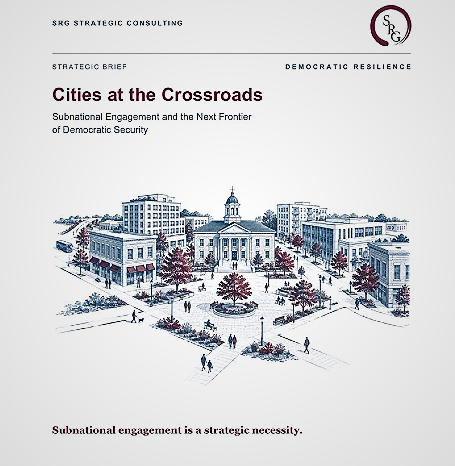
If you’ve followed my work over the last few years, you may have noticed a theme whether the topic is election security, artificial intelligence, data center growth, communications planning, or critical minerals supply. The connecting thread through all of it seems simple on the surface: cities and states—or subnational actors—must be involved and engaged as federal policymakers navigate an increasingly complex 21st century landscape.
With the midterms behind us a new Congress taking office in January, policymakers need a working understanding of how security and foreign policy decisions land with governors, legislators, mayors, city councils, and the people they serve. Subnational leaders need the same understanding in reverse: what they decide can advance national priorities or quietly undercut them. We no longer live in a time where a state representative can simply say, “I didn’t think we were allowed to touch that, I thought those things were left to Defense or State.”
A global race for critical minerals means state and local leaders must understand which decisions and responsibilities remain theirs. Consider a county weighing a data center proposal while Congress debates federal permitting reform. The county is considering land, water, electricity, and the community’s future. Federal policymakers are planning around mineral supplies and infrastructure needed for data centers, defense production, and the grid that powers our homes and our defense systems. Those decisions need to inform one another. Federal planners need to understand local constraints, and local leaders need visibility into the wider dependencies their decisions affect. That gap between the needs of the country and the experiences of its people is one of the widest I see.
That void is what Cities at the Crossroads begins to examine: how weaknesses in local institutions create openings for disinformation, cyber intrusion, and coercive investment—and how those same institutions can strengthen democratic resilience when they have the relationships, resources, and information to act.
A central distinction in the brief is between subnational diplomacy and subnational engagement. Diplomacy encompasses the international partnerships cities and states pursue. Engagement connects local knowledge and experience to decisions made across levels of government. It gives national policymakers a clearer understanding of the communities affected by their decisions, while helping local leaders understand the wider implications of their own.
The brief closes with five recommendations addressing that relationship: bringing subnational actors into security and resilience planning, investing in strategic communications, building coordination around local expertise, supporting civic coalitions, and developing the research and training needed to sustain this work. These are institutional responsibilities that require people, resources, and continuing attention.
Which brings me back to that question over breakfast. Part of the answer is making sure the conversation moves in both directions. The people on the ground have knowledge that should inform national policy as it is being developed. Their ability to recognize risks, explain decisions, and maintain public trust is part of the country’s ability to act.
You can read the full brief online or download the PDF below. If your work brings you into these conversations, I’d like to hear where coordination is working and where you’re seeing gaps that cause friction. Reply to this email, send a note to inquiries@srgstrategicconsulting.com, or use the inquiry form at srgstrategic.com.
All my best,